






The Polyvagal Theory: Ventral and Dorsal Vagal Systems
The Polyvagal Theory: Ventral and Dorsal Vagal Systems
Dr Stephen W. Porges, a neuroscientist and behavioural researcher, introduced the Polyvagal Theory in the 1990s to explain how the vagus nerve underpins emotional regulation, social behaviour, and responses to stress. His model reframed our understanding of the autonomic nervous system (ANS) as a hierarchical system with adaptive states, rather than a simple binary between sympathetic “fight-or-flight” and parasympathetic “rest-and-digest”.
According to Porges, the vagus nerve (cranial nerve X) contains two major branches, the ventral vagal complex and the dorsal vagal complex, each supporting distinct physiological and behavioural states. These systems evolved sequentially and are activated according to perceived safety or threat.

Evolutionary Hierarchy of Autonomic States
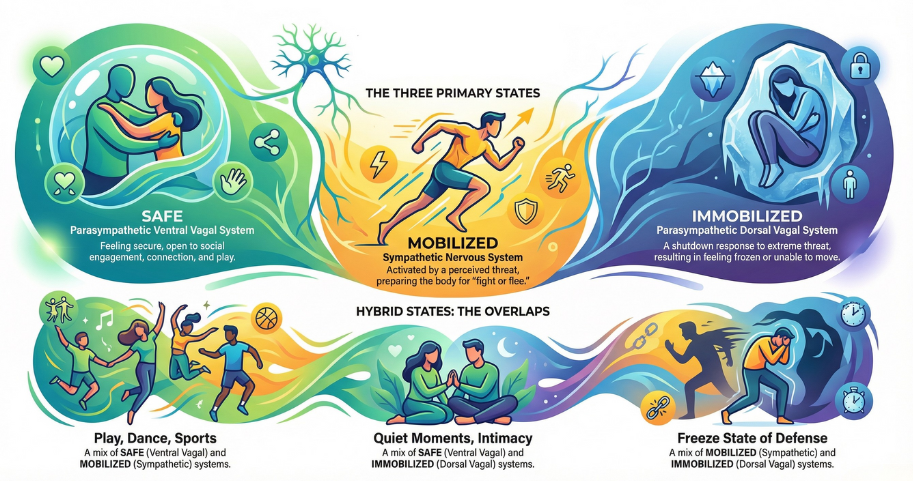
Porges proposed that the human autonomic nervous system is organised according to an evolutionary hierarchy of responses to environmental challenge:
- Ventral vagal system (myelinated vagus) – supports social engagement and calm behavioural states.
- The sympathetic nervous system mobilises the body for active defence: fight or flight.
- Dorsal vagal system (unmyelinated vagus) – promotes immobilisation, energy conservation, or shutdown in the face of extreme threat.
These systems are not mutually exclusive but interact dynamically to regulate physiological and psychological adaptation. The ventral vagal system represents the most recently evolved pathway, enabling social communication and co-regulation among humans and other mammals.
The Ventral Vagal System: Social Engagement and Safety
The ventral vagal complex (VVC) originates in the nucleus ambiguus of the brainstem and is composed of myelinated fibres that allow for rapid, precise control of the heart and face. This system is often referred to as the “social engagement system.”
- Physiological function: The VVC slows heart rate, promotes digestion, and supports calm alertness. It is active when an individual perceives safety.
- Social behaviour: It coordinates facial expression, prosody (tone of voice), eye contact, and head movement, all of which contribute to interpersonal communication and emotional connection.
- Neuroception of safety: When the environment is perceived as safe, the ventral vagal system dominates, inhibiting sympathetic arousal and dorsal shutdown. This enables play, intimacy, learning, and therapeutic engagement.
In clinical and therapeutic contexts, ventral vagal activation is associated with emotional resilience, regulation of affect, and secure attachment behaviours. Techniques such as slow breathing, mindfulness, and social connection can strengthen ventral vagal tone.
The Social Engagement System and Emotional Safety Cues
The social engagement system is a concept within Stephen Porges’ Polyvagal Theory that describes how the ventral vagal complex coordinates facial expression, voice, hearing, and heart regulation to foster connection and a sense of safety. When active, it allows humans to engage socially, communicate calmly, and co-regulate emotional states with others.
This system integrates muscles of the face, head, and neck - controlled by cranial nerves (V, VII, IX, X, XI) - with the myelinated ventral vagus nerve, which slows the heart and promotes calm alertness. Through this pathway, physiological state and emotional communication become directly linked. When we feel safe, our facial tone softens, our voice becomes melodic, and our breathing steadies: all cues that signal approachability and trust.
Key Emotional Safety Cues:
Facial expression: Soft eyes, relaxed jaw, and gentle smiles indicate safety and openness.
Vocal prosody: Warm tone, varied pitch, and rhythmic pacing conveys friendliness and reassurance.
Eye contact: Sustained but non-threatening gaze promotes connection and empathy.
Body posture: Upright yet relaxed posture and slow gestures communicate calm presence.
Breathing rhythm: Slow, steady breathing helps stabilise vagal tone and invites co-regulation in others.
In therapy and social interaction, recognising and fostering these cues can shift physiological state from defensive activation (fight/flight or freeze) to ventral vagal engagement. This transition is essential for emotional regulation, trust formation, and relational healing.
Conversely, absence of safety cues (such as flat affect, monotone speech, or avoidance of eye contact) may signal that the nervous system has shifted into sympathetic arousal or dorsal shutdown. Attuning to these subtle physiological markers allows practitioners and individuals to work consciously toward restoring a sense of safety, connection, and co-regulated calm.
The Dorsal Vagal System: Immobilisation and Conservation
The dorsal vagal complex (DVC) arises from the dorsal motor nucleus of the vagus and consists of unmyelinated fibres, an evolutionarily older parasympathetic pathway associated with energy conservation and immobilisation under extreme threat. It regulates subdiaphragmatic organs, such as the stomach and intestines, and conserves energy during extreme states of threat.
- Physiological function: When strongly activated, the dorsal vagus can produce bradycardia (slowed heart rate), reduced blood pressure, and decreased metabolic activity.
- Defensive shutdown: This system mediates the “freeze”, “collapse”, or “faint” responses associated with overwhelming danger, trauma, or perceived inescapability.
- Clinical relevance: In humans, chronic dorsal vagal dominance is linked with dissociation, fatigue, depression, and functional disorders of digestion (e.g., IBS, gastroparesis).
The dorsal vagal system can be adaptive - for instance, in conserving energy or in feigning death in animals - but in modern humans, it may underlie maladaptive shutdown responses in trauma and chronic stress.
Neuroception: The Detection of Safety and Danger
Porges introduced the term neuroception to describe the unconscious neural evaluation of environmental safety. The brain continuously monitors sensory cues from the environment, body, and social context to determine which autonomic state is appropriate.
- Safe cues activate the ventral vagal system and promote social engagement.
- Threat cues trigger sympathetic arousal (the fight-or-flight response).
- Overwhelming threat shifts the system into dorsal vagal shutdown.
Neuroception explains how physiological states can shift rapidly and without conscious control, shaping behaviour, posture, and emotional tone before cognitive appraisal occurs.
Polyvagal Theory and Psychophysiological Regulation
The Polyvagal model has significant implications for understanding stress-related and trauma-related conditions. Therapeutic work informed by Porges’ theory often aims to restore ventral vagal dominance and expand the individual’s “window of tolerance”.
Clinical and experimental evidence supports the idea that enhancing vagal tone (indirectly through vagus nerve stimulation, breathwork, mindfulness, or interpersonal safety) can improve emotional regulation, reduce inflammation, and promote well-being.
In applied fields such as psychotherapy, somatic therapies, and IEMT, practitioners use the model to understand client states of hyperarousal (sympathetic) or hypoarousal (dorsal) and to facilitate transition toward the socially engaged ventral state where integration and healing occur.
Summary Table: Comparison of Vagal Systems
| Feature | Ventral Vagal System | Dorsal Vagal System |
|---|---|---|
| Origin | Nucleus ambiguus (brainstem) | Dorsal motor nucleus of the vagus |
| Fibre Type | Myelinated (fast conduction) | Unmyelinated (slow conduction) |
| Primary Function | Social engagement, calm state, heart rate regulation | Immobilisation, energy conservation, digestive regulation |
| Associated Emotional State | Safety, connection, curiosity | Shutdown, numbness, dissociation |
| Clinical Correlates | Emotional resilience, self-soothing, engagement in therapy | Shutdown, trauma freeze response, chronic fatigue |
Critiques and Limitations of Polyvagal Theory
While Stephen Porges’ Polyvagal Theory has been influential in psychology, neuroscience, and trauma therapy, it has not gone unchallenged. The theory provides a valuable framework for understanding physiological regulation and emotional safety, but researchers and clinicians have noted several scientific and conceptual limitations.
1. Limited Empirical Validation
Although Polyvagal Theory is supported by indirect physiological evidence (such as heart rate variability and vagal tone studies), critics argue that there is insufficient direct anatomical and experimental data distinguishing the “ventral” and “dorsal” vagal branches in the way Porges describes. Some neuroscientists suggest that the functional boundaries between these systems are less clear-cut than the model implies.
2. Evolutionary Claims Under Debate
Porges’ model proposes an evolutionary hierarchy from reptilian immobility (dorsal vagal) to mammalian social engagement (ventral vagal). However, comparative neuroanatomists point out that evidence for such a strict evolutionary sequence is incomplete. The idea that social behaviours evolved uniquely through vagal myelination has been questioned, as similar mechanisms exist in non-mammalian species.
3. Overgeneralisation in Therapeutic Contexts
Polyvagal Theory has been enthusiastically adopted in therapy and trauma work, but some critics caution against using it as a diagnostic or explanatory model for all emotional states. There is concern that practitioners may overinterpret complex behaviours or emotions purely through a vagal lens, neglecting cognitive, social, and cultural influences.
4. Conceptual Ambiguity
Key constructs such as “neuroception” (the unconscious detection of safety or threat) are conceptually appealing but difficult to operationalise and measure scientifically. Without clear biomarkers or consistent metrics, these ideas remain largely theoretical.
5. Integration with Broader Neuroscience
Modern neuroscience recognises the vagus nerve as part of a complex network involving cortical, subcortical, and endocrine systems. Some researchers argue that Polyvagal Theory under-represents the role of higher brain regions (e.g., the prefrontal cortex) in emotion regulation and social behaviour. The theory’s emphasis on the brainstem may therefore oversimplify the broader picture of human affective neuroscience.
Balanced Perspective
Despite these critiques, Polyvagal Theory remains a valuable heuristic framework. It has helped bridge physiological science and clinical practice by emphasising the role of safety, connection, and co-regulation in mental health. Its terminology has entered the therapeutic lexicon and inspired empirical studies into vagal tone, trauma recovery, and social engagement.
Future research continues to refine and test the model, integrating it with advances in neuroimaging, psychophysiology, and social neuroscience. As such, the theory’s most significant contribution may lie not in its anatomical precision but in its clinical utility and paradigm shift toward understanding the body’s role in emotional experience and healing.
Implications for Therapy and Wellbeing
The distinction between the ventral and dorsal vagal systems provides a nuanced understanding of human behaviour under stress. It invites therapists and clinicians to view emotional dysregulation not as pathology, but as an adaptive physiological response. By fostering neuroception of safety and supporting ventral vagal activation, therapeutic processes can help clients move from defensive to connected states, enabling integration, empathy, and resilience.
Ultimately, Porges’ Polyvagal Theory bridges physiology and psychology, offering a biological framework for compassion, regulation, and healing.

External Critical Commentary:
A Critical Perspective on Polyvagal Theory. Neuroscience & Psychotherapy.