






Caloric Ear Irrigation, Body-Image Distortion, and the Vagus Nerve
Summary: This page brings together the history and rationale of irrigating the ear canals with cold or warm water (caloric* vestibular stimulation) as a way to alter body representation transiently, why this idea was floated in relation to anorexia nervosa, how it connects, indirectly, to the vagus nerve, what the evidence shows so far, and important safety and ethical notes. The technique remains experimental in the context of eating disorders and should not be used as self-help.
*caloric refers to temperature.
What is Caloric Vestibular Stimulation (CVS)?
Caloric vestibular stimulation is a neuro-otological procedure in which the external auditory canal is irrigated with cold or warm water (or air) to stimulate the inner ear’s vestibular apparatus. The temperature gradient alters endolymph density in the horizontal semicircular canal, producing a predictable nystagmus and sensations of vertigo. In clinical neurophysiology, it is a diagnostic tool; in cognitive neuroscience, it has been used as a brief neuromodulatory probe of spatial attention, body representation, and interoception.
- Primary target: Vestibular system (cranial nerve VIII).
- Typical effects (seconds–minutes): Nystagmus (squiffy eyes), dizziness, postural sway (wobbly), shifts in spatial orientation (trippy), and nausea (nasty) in some individuals.
- Research observations: In some paradigms, CVS can transiently modulate hemispheric networks involved in body schema (right parietal–insular circuits), neglect, and even affective states. Findings are mixed and generally short-lived.
The Caloric Reflex Test
In medicine, the caloric reflex test - also known as vestibular caloric stimulation - is a diagnostic procedure used to assess the vestibulo-ocular reflex, which stabilises vision during head movement. The test involves gently irrigating the external auditory canal with either warm or cold water or air, producing a temperature gradient that stimulates the inner ear’s semicircular canals.
This thermal change alters the flow of endolymph within the vestibular apparatus, triggering characteristic involuntary eye movements (nystagmus) that reveal whether each ear’s vestibular system is functioning properly.
The method was developed by Robert Bárány, an Austrian otologist and neurologist, who received the 1914 Nobel Prize in Physiology or Medicine for this discovery: a milestone in understanding balance, spatial orientation, and the inner ear’s role in reflexive eye control.
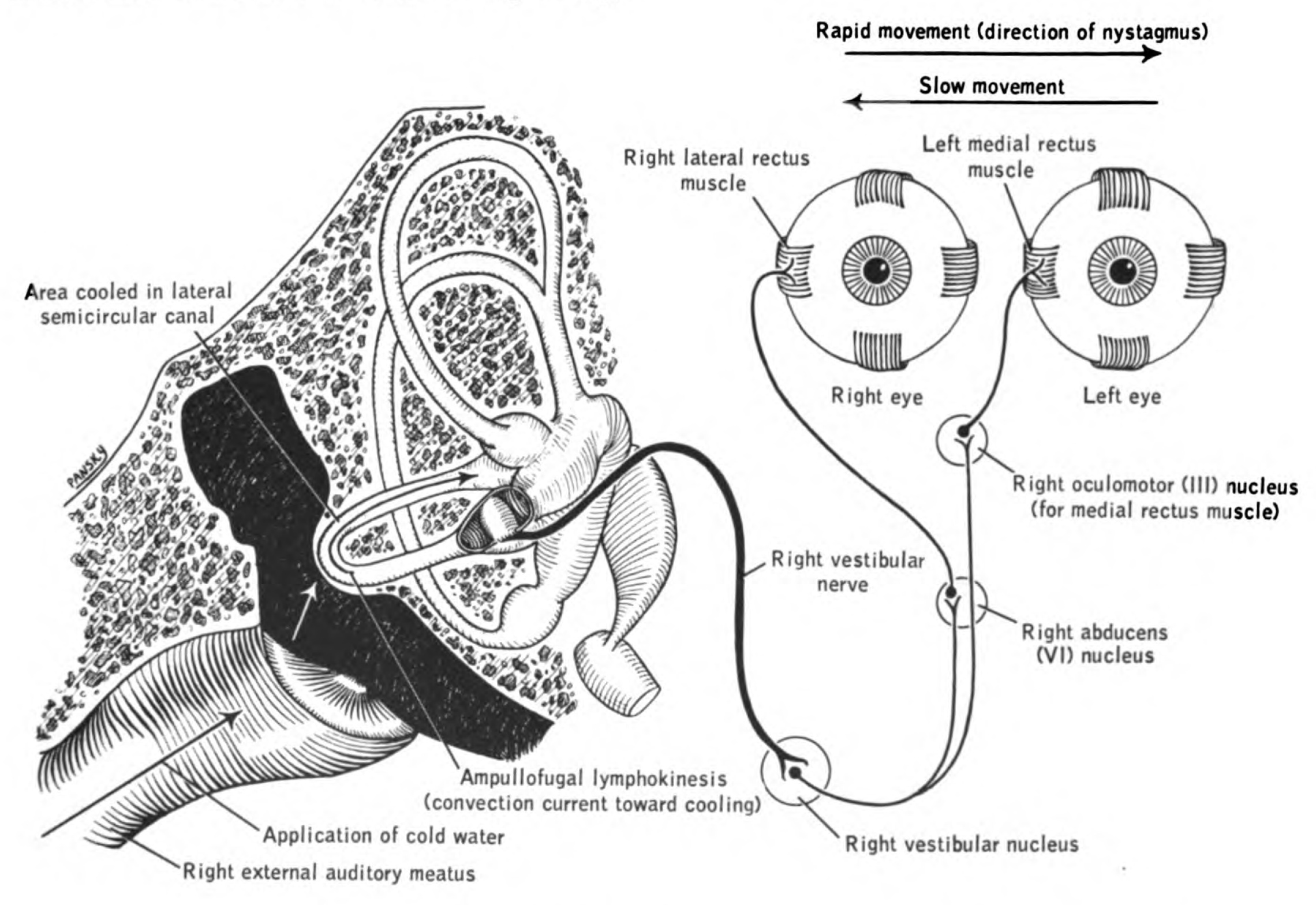
Source: House, E. L., & Pansky, B. (1960). A functional approach to neuroanatomy.
License: Public Domain (United States; copyright not renewed).
Why was it proposed for Anorexia Nervosa?
From bedside observations that CVS can briefly “reset” aspects of spatial and bodily representation, some authors have hypothesised that similar stimulation might reduce the distorted body image seen in anorexia nervosa. In popular science writing, this suggestion has been explicitly stated as a speculative, low-dose, time-limited probe to test whether shifting vestibular–parietal processing could soften body-size overestimation. This remains a theoretical extrapolation, inspired by analogies to work in hemispatial neglect and anosognosia, not an established therapy.
Key point: The proposed benefit is about transient modulation of body representation networks, not about nutrition, weight restoration, or the broader biopsychosocial treatment of anorexia nervosa.
Is this related to the Vagus Nerve?
Indirectly, yes. Caloric irrigation primarily excites vestibular afferents (CN VIII), but the skin of the external auditory canal, the place where irrigation happens, has dual sensory innervation that includes the auricular branch of the vagus nerve (often called Arnold’s or the Alderman’s nerve). Stimulation of this region can send vagal afferent signals to the nucleus tractus solitarius (NTS) in the brainstem, which communicates with autonomic and limbic circuits.
- Vestibular route (primary): Ear canal temperature gradient → semicircular canal endolymph shift → vestibular nerve → vestibular nuclei → parietal–insular networks.
- Auricular vagal route (incidental/secondary): Mechanical/thermal stimulation of posterior–inferior ear canal skin → auricular branch of CN X → NTS → autonomic/affective modulation.
This overlap explains why some modern neuromodulation approaches (e.g., transcutaneous auricular vagus nerve stimulation, taVNS) place electrodes on the concha or tragus: areas with vagal afferents. However, CVS ≠ taVNS: their primary targets, dosing, and mechanisms differ, even though the ear is the common access point.
| Modality | Primary Target | Access Site | Main Mechanism | Typical Intent |
|---|---|---|---|---|
| Caloric vestibular stimulation (CVS) | Vestibular apparatus (CN VIII) | External auditory canal (water/air) | Thermal gradient → endolymph flow → vestibular nuclei | Diagnostics; experimental modulation of body/spatial processing |
| Transcutaneous auricular VNS (taVNS) | Auricular branch of the vagus (CN X) | Concha/tragus (surface electrode) | Afferent vagal activation → NTS → parasympathetic/limbic pathways | Experimental/adjunct modulation of autonomic and affective function |
Pathways Relevant to Body-Image and Interoception
- Vestibular–parietal–insular networks: CVS can bias right-hemisphere circuits implicated in bodily awareness and size estimation. Any observed effect tends to be brief and heterogeneous across individuals.
- Vagal afferent “spill-in”: Ear-canal stimulation may incidentally recruit auricular vagal fibres, relaying to the NTS and influencing the dorsal motor nucleus of the vagus, nucleus ambiguus, hypothalamus, and limbic structures—potentially nudging parasympathetic tone, interoceptive awareness, and affect.
- Integration hypothesis: In theory, a combined vestibular–vagal nudge could transiently alter the weighting of exteroceptive vs interoceptive signals that inform body representation. Evidence so far is limited and mixed.
What does the evidence show for Anorexia Nervosa?
- No established clinical therapy: CVS is not a recognised treatment for anorexia nervosa. It does not replace nutritional rehabilitation, medical risk management, psychotherapy, or family-based interventions.
- Small experimental literature: Studies in healthy volunteers indicate that CVS can sometimes shift facets of perceived body dimensions or affective state, but effects are short-lived and inconsistent. Research directly in eating-disorder populations is scarce, typically small-n, and exploratory.
- State of the field: Where neuromodulation is researched in eating disorders, most clinical attention has gone to rTMS, tDCS, and invasive DBS—not CVS. Auricular vagus stimulation remains experimental, with emerging but preliminary data in broader affective/autonomic domains.
Bottom line: The anorexia application of CVS remains a hypothesis-generating idea. At present there is no robust clinical-grade evidence that it improves eating-disorder symptoms or outcomes.
Learn more...
Click images to purchase.


Safety, Contraindications, and Practical Constraints
Don't be a nitwit and try this at home. CVS is a clinical procedure performed with controlled volumes, temperatures, and head positioning by people who actually know what they are doing, unlike you. It commonly induces dizziness and nystagmus and may provoke nausea. It is not appropriate for self-experimentation.
Common transient effects
- Vertigo, nystagmus, imbalance.
- Nausea, autonomic discomfort.
- Brief disorientation or anxiety in sensitive individuals.
Contraindications & cautions
- Perforated tympanic membrane, grommets, chronic otitis, recent ear surgery
- Known vestibular disorders or severe motion sickness
- Acute migraine, unstable cardiorespiratory disease, or situations where sudden vertigo increases the risk of falls
- Poor physiological reserve (malnourished patients are medically fragile; any research use demands medical oversight)
Research-only protocol notes (illustrative, not instructions)
- Temperature & dose: Conventional clinical testing ranges around ~30°C (cold) or ~44°C (warm), with small volumes over brief periods; exact parameters vary by lab and are determined by safety SOPs.
- Head position: Typically 30° head elevation to align the horizontal canal.
- Monitoring: Continuous supervision; stop for pain, severe nausea, anxiety, or otologic symptoms.
Important: For individuals with eating disorders (who may have electrolyte imbalance, bradycardia, hypotension, or bone fragility) any experimental neuromodulation should be embedded in a multidisciplinary care plan with explicit risk assessment and capacity/consent checks.
How this compares with taVNS and other neuromodulation approaches
- taVNS: Electrically stimulates auricular vagal afferents through the skin. Aims to modulate parasympathetic tone, inflammation pathways, and affective circuits. Parameters include pulse width, frequency, and duty cycle; trials are ongoing across anxiety, depression, pain, and autonomic conditions. Evidence in eating disorders is preliminary.
- rTMS/tDCS: Target cortical nodes (e.g., dorsolateral prefrontal cortex) implicated in executive control and reward/valuation; several controlled studies exist in eating disorders, though effect sizes and protocols vary.
- DBS: Invasive and reserved for severe, refractory cases within research settings.
- CVS: Very short-acting probe of vestibular–parietal function with possible incidental vagal input; currently a research tool rather than a treatment.
Conceptual Model: Where Might Any Benefit Come From?
- Body-schema recalibration (vestibular): Brief reweighting of spatial/vestibular inputs within right parietal–insular networks could momentarily reduce size overestimation or allocentric distortions.
- Interoceptive/affective shift (vagal): Incidental auricular vagal activation might increase parasympathetic tone, dampen arousal, or alter interoceptive salience—potentially lowering anxiety linked to body image or eating.
- Multi-system nudge: The combined vestibular–vagal effects may produce a short “window” of altered bodily self-processing that could, in theory, be paired with therapeutic exercises (e.g., mirror exposure, interoceptive training). This pairing remains hypothetical and untested at scale.
Ethical and Clinical Considerations in Eating-Disorder Care
- Medical safety first: Malnutrition, electrolyte imbalance, and bradycardia elevate risk. Any research stimulation should be cleared medically with on-site monitoring.
- Informed consent & capacity: Ensure understanding of experimental status, transient effects, and alternatives; avoid therapeutic misconception.
- Trauma-informed practice: Dizziness and bodily sensations can be distressing; pre-briefing, grounding strategies, and opt-out protocols are essential.
- Integration with evidence-based care: If explored in a trial, stimulation should be an adjunct to standard multidisciplinary treatment, with clear outcome measures (body-image distortion tasks, interoceptive accuracy, autonomic markers such as HRV), adverse-event logging, and predefined stopping rules.
Practical Takeaways
- Caloric ear irrigation is a vestibular test that can transiently modulate body- and spatial-processing; its application to anorexia is hypothesis-driven and experimental.
- The procedure may incidentally stimulate auricular vagal fibres, linking it conceptually (but not equivalently) to taVNS.
- No clinical recommendation can be made for CVS in anorexia nervosa at this time.
- Any exploration should occur only under formal research protocols with medical oversight, not as a self-administered intervention.