






Shame vs Guilt vs Fear: A Comparison (IEMT Perspective)
Although shame, guilt, and fear are often used interchangeably in everyday language, they function very differently in clinical practice.
From an Integral Eye Movement Technique (IEMT) perspective, the key distinction is the emotion is the organising principle: the self (shame), behaviour (guilt), or danger (fear). Accurate differentiation matters because each state tends to stabilise distinct coping, language, and identity positions.
At-a-glance distinctions
- Shame: organised around the whole self (“I am bad / defective / unworthy”).
- Guilt: organised around behaviour (“I did something wrong / I should repair it”).
- Fear: organised around danger (“I’m not safe / I need to escape or protect myself”).
Shame
Clinical focus: Whole self – Identity. Shame is identity-proximal, and it is typically experienced as exposure, defectiveness, or being fundamentally “less-than” the idealised self (or perfected self). The person may continue to strive to behave well while perceiving themselves as defective at an identity level, even though no actual wrongdoing is ever present.
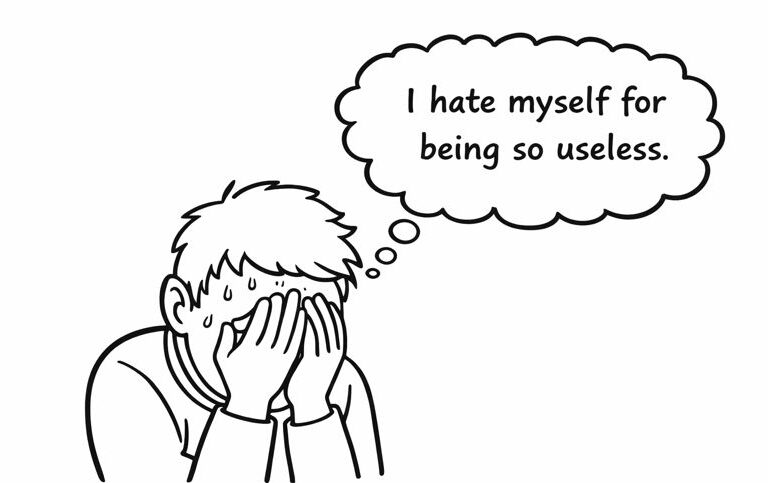
Common triggers: situations involving evaluation, visibility, criticism, humiliation, comparison, or anticipated rejection. A common trigger is during social occasions, where the person picks the wrong script for their persona, potentially revealing a self-referential inauthenticity.
Identity impact: shame tends to generate global self-appraisals that traverse across contexts (e.g., “I am bad", “I am wrong", “I am unworthy", “I don’t belong”). This globality often drives concealment, collapse, avoidance of intimacy, and self-attack. Ironically, overcompensation for shame avoidance may manifest as even greater effort in scripting and enacting social personas, leading to further inauthenticity.
Guilt
Clinical focus: Behaviour. Guilt is usually behaviourally-oriented and morally structured. Unlike shame, guilt tends to preserve the possibility of repair: the person can remain “good” while acknowledging wrongdoing. It should be noted that objectively measured wrongdoing is not necessary for guilt to arise, as guilt (like shame) may result from a categorisation error.
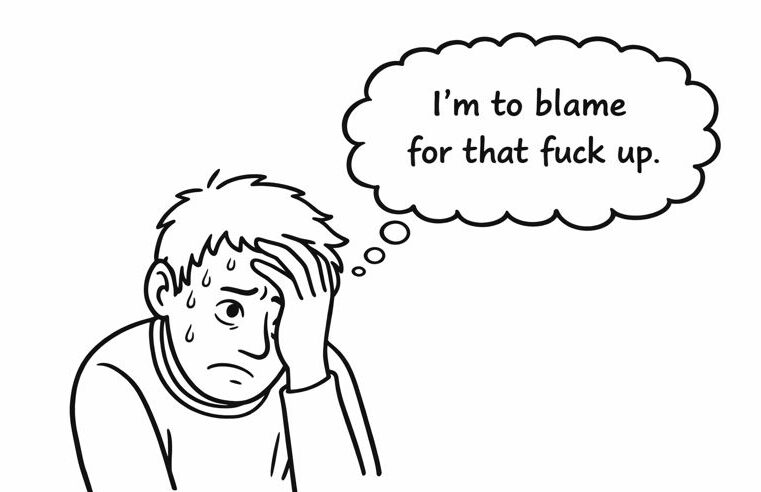
Common triggers: breaking a rule, violating a personal value, harming someone, omission (not doing what one believes one should have done), or failing to meet obligations.
Identity impact: guilt typically produces a repair impulse (e.g., an apology, restitution, or changed behaviour). When unresolved or excessive, guilt can become chronic self-monitoring, rumination, and compulsive responsibility-taking.
- IEMT note: persistent guilt can still become identity-adjacent shame when “I did wrong” silently shifts toward “I am wrong". Differentiation is clinically important.
Categorisation error in emotional experience
A categorisation error occurs when an internal experience is assigned to the wrong conceptual category. In the case of guilt, this means the emotion is organised as if a moral transgression has occurred, even when no objectively identifiable wrongdoing is present. The individual experiences a felt certainty that they have done something wrong, despite the absence of any clear behavioural violation.
Categorisation errors of this type often arise from early learning, problematic parenting, relational conditioning, or repeated misattribution of responsibility. Over time, internal states such as discomfort, anxiety, or relational tension become automatically labelled as “my fault". Once established, the emotional system responds as though repair, apology, or self-punishment is required, even when no corrective action is logically appropriate.
All of this, of course, can lead the person to make mistakes, thus recursively confirming the sense of guilt.
From an IEMT perspective, this is not a failure of reasoning but an error in emotional organisation: the emotion has been grouped under the category of guilt rather than being recognised as another state (e.g., fear, shame, uncertainty, or relational threat). Effective intervention, therefore, focuses on recalibrating the emotional pattern itself, rather than debating facts or attempting cognitive reassurance.
Fear
Clinical focus: Danger. Fear is threat-based and oriented toward safety. It activates protective physiology and mobilises defensive actions. Fear may be extrinsic to self (i.e., "the lion is the hazard"), or intrinsic to self ("I am the hazard"). This distinction is important – anxiety may be seen to be concern about what may happen, but intrinsic fear may be about "what I may cause to happen". Hopefully, readers will readily see the link here to anticipated guilt and shame.
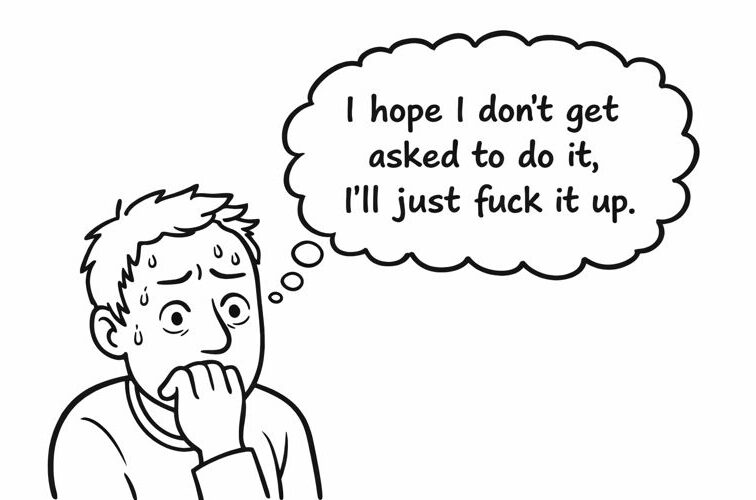
Common triggers include threat cues (real or perceived), unpredictability, risk of harm, reminders of danger, or contexts associated with prior threats. Chronic fear may appear as panic, hypervigilance, avoidance, or startle responses.
Identity impact: fear often leaves people feeling vulnerable and unresourceful (e.g., “I’m not safe,” “I need to escape,” “Something bad is going to happen”). Chronic fear can shape identity indirectly through persistent threat-monitoring, restriction of life activities and confirmation bias. As such, chronic fear may serve as an agonist to shame by promoting a negative self-concept of inadequacy.
IEMT practitioners should immediately recognise the connection to the pattern of chronicity known as the Great Big What If Question.
Expanded At-a-Glance Distinctions
| Dimension | Fear | Guilt | Shame |
|---|---|---|---|
| Physiological activation | Fight–flight–freeze response; heightened arousal; adrenaline surge. | Internal tension with approach tendency (e.g., urge to confess or repair). | Collapse or withdrawal; reduced energy; slumped posture; desire to hide. |
| Adaptive function | Immediate survival and protection from threat. | Social and moral repair; relationship preservation. | Conformity to group ideals; signals social risk (often maladaptive in excess, leading to isolation). |
| Typical behavioural response | Avoidance, escape, freezing, or hypervigilance. | Reparative action (apology, restitution, corrective behaviour). | Hiding, self-attack, withdrawal, or overcompensation (e.g., perfectionism). |
| Potential for positive outcome | Motivates precaution, preparation, and risk avoidance. | Promotes prosocial change and restored relationships. | May drive self-improvement if resolved; often reinforces negative identity if unresolved. |
Physiological and Behavioural Markers
Differentiating fear, guilt, and shame clinically often involves attending to subtle physiological and behavioural cues. These markers align closely with the organising principles of each emotional state and can be observed even when clients struggle to articulate their internal experience.
| Emotion | Physiological markers | Behavioural markers | IEMT-relevant note |
|---|---|---|---|
| Shame | Downward gaze aversion, blushing, slumped posture, reduced physical expansion, and a felt sense of “shrinking” or smallness. | Withdrawal, concealment, self-attack, or aggressive overcompensation to mask perceived defectiveness. | Shame imprints are identity-proximal and often resistant to change through insight or behavioural correction alone. |
| Guilt | Internal tension, restlessness, and a forward-leaning or approach-oriented posture. | Confession, apology, repair attempts, increased responsibility-taking or monitoring. | Guilt preserves agency (“I can fix this”) but may become chronic through over-responsibility. |
| Fear | Heightened autonomic arousal (e.g., increased heart rate, startle response), muscular tension, scanning, or frozen posture. | Avoidance, safety-seeking, checking, preparation, or escape behaviours. | Chronic fear often links to the IEMT “Great Big What If Question", maintaining anticipatory threat and hypervigilance. |
Accurate observation of these markers supports precise IEMT intervention by targeting the correct emotional organisation, rather than relying solely on the client's self-report.
Additional Distinctions to Enhance the Comparison
| Dimension | Shame | Guilt | Fear |
|---|---|---|---|
| Primary organising principle | Self / identity (“Who I am”). | Behaviour (“What I did or failed to do”). | Danger / threat (“What might happen”). |
| Temporal orientation | Timeless and global (“It’s always been this way”). | Past-oriented but correctable (“I can put this right”). | Future-oriented (“What if…?”). |
| Physiological activation | Collapse or withdrawal; reduced expansion; urge to hide. | Internal tension with an approach tendency (an urge to confess or repair). | Fight–flight–freeze response; heightened arousal and adrenaline. |
| Adaptive function | Signals risk of social exclusion; promotes conformity to group ideals (often maladaptive when chronic). | Supports moral repair and relationship preservation. | Ensures immediate survival and protection. |
| Typical behavioural response | Withdrawal, concealment, self-attack, or overcompensation (e.g., perfectionism). | Apology, restitution, corrective action, and increased responsibility-taking. | Avoidance, escape, hypervigilance, and safety behaviours. |
| Language patterns | Identity statements (“I am bad / wrong / defective”). | Action statements (“I did something wrong / I should fix this”). | Threat forecasting (“What if…?” “Something bad will happen”). |
| Potential positive outcome | May motivate self-improvement if resolved; otherwise reinforces a negative identity. | Promotes prosocial change and restored trust. | Encourages precaution, planning, and risk avoidance. |
Overlaps, Transitions, and Misattribution Risks
| Pattern | Clinical description | IEMT relevance |
|---|---|---|
| Fear → Guilt | Anticipatory fear (“What if something goes wrong?”) shifts into responsibility attribution (“It will be my fault”). | Common pathway into chronic guilt via threat-based misattribution. |
| Guilt → Shame | Behavioural fault (“I did wrong”) silently globalises into identity judgement (“I am wrong”). | Signals a shift from reparable guilt into identity-proximal shame. |
| Fear amplifying shame | Fear of exposure, rejection, or failure intensifies shame and concealment. | Creates feedback loops maintaining chronicity. |
| Intrinsic vs extrinsic fear | Fear may be about external danger (“the threat”) or internal danger (“I am the risk”). | Intrinsic fear often feeds anticipated guilt and shame. |
These overlaps highlight why accurate emotional differentiation is essential in IEMT. Patterns of chronicity (such as the “Great Big What If Question”) often originate in fear but stabilise through guilt and shame-based identity conclusions.
Why this matters clinically (IEMT perspective)
Mislabelling shame as guilt (or vice versa) can lead to ineffective interventions. For example, encouraging “repair” behaviours may help guilt but may inadvertently reinforce shame by keeping the focus on defectiveness. Similarly, treating shame primarily as fear can overemphasise safety strategies while leaving identity-linked emotional patterning unchanged.
In IEMT, understanding differentiation helps the practitioner work with the emotion as it is organised, self (shame), behaviour (guilt), or danger (fear), and to target the pattern rather than relying solely on narrative exploration or cognitive disputation.
Mooi onderscheid gemaakt. belangrijk dus om zelf helder van geest te blijven.
Bij PTSS protocol kan iemand bijvoorbeeld zeggen: ‘ik was zo bang’ terwijl hij daarbij schaamte voelt. Door gewoon de zin van de client te behandelen pak je de schaamte mee