





Dealing with Abreactions
The Three-Stage Abreaction
Physiology of Shell Shock:
The British Pathe archive is here: https://www.youtube.com/channel/UCGp4u0WHLsK8OAxnvwiTyhA
And, then there's this...
Dealing with Abreactions in Integral Eye Movement Technique (IEMT)
Abreaction is a well-documented phenomenon within psychotherapy, referring to the sudden emergence of intense emotional, physiological, or behavioural responses during therapeutic intervention. Within Integral Eye Movement Technique (IEMT), such responses may arise when neurological patterns associated with emotional or identity encoding are destabilised.
Abreaction as a Clinical and Training Phenomenon
In the context of IEMT, abreaction is not viewed as evidence of therapeutic depth or effectiveness, but rather as an indicator that the nervous system has exceeded its current capacity for adaptive processing. While mild emotional activation is common during eye movement work, full abreaction represents a loss of regulatory balance, often characterised by heightened affect, dissociation, involuntary movement, or dramatic behavioural expression.
Importantly, abreactions are more frequently observed in training environments than in routine clinical practice. This is largely due to contextual variables such as group attention, observational pressure, and the inadvertent reinforcement of dramatic responses.
Attention as an Amplifier of Response
A central principle in managing abreaction is the recognition that attention functions as an amplifier. When a client or trainee becomes the focus of collective attention (particularly in group settings) the nervous system may escalate its response in order to maintain coherence or significance within the social field.
Therapist behaviours such as intense monitoring, verbal reassurance, physical proximity, or repeated questioning can unintentionally reinforce the reaction. Rather than stabilising the individual, such responses may increase arousal by signalling that something significant or dangerous is occurring.
Strategic Non-Intervention and “Closing It Down”
Contrary to instinctive responses, effective management of abreaction often involves doing less rather than more. Strategic non-intervention, ie. reducing verbal input, withdrawing attention, and allowing the nervous system to self-regulate, frequently leads to rapid de-escalation.
In IEMT practice, this may involve calmly instructing the individual to stop the process, orient to the room, or disengage from the stimulus without analysis or emotional processing. The objective is not catharsis, but neurological stabilisation.
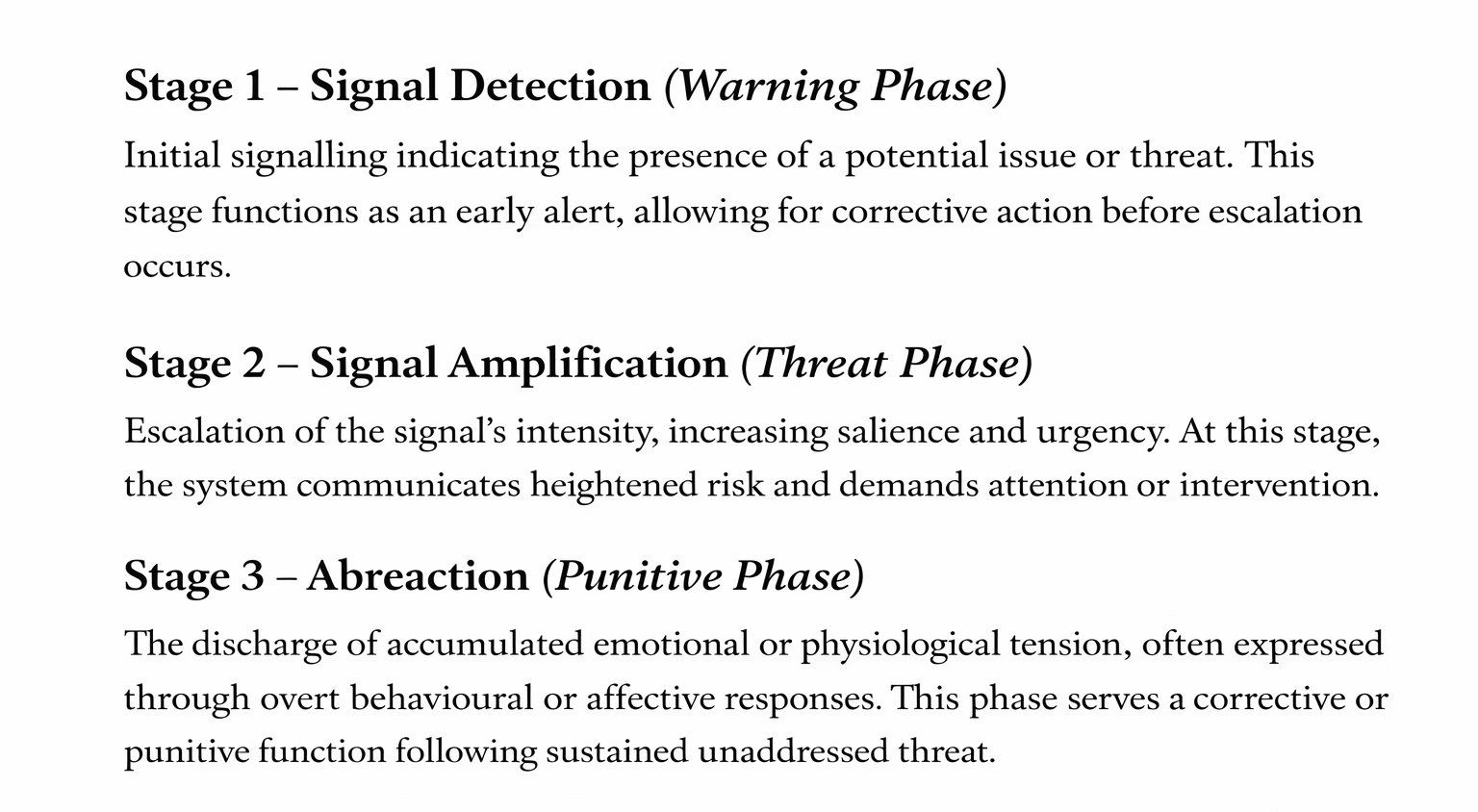
A Three-Stage Escalation Model
Abreaction can be usefully conceptualised as progressing through three stages. The first stage involves mild activation, such as tearfulness, muscle tension, or changes in breathing. At this level, simple interruption or redirection is typically sufficient.
The second stage is marked by behavioural amplification, including rocking, shaking, or vocalisation. Here, continued attention or encouragement risks pushing the individual further into dysregulation.
The third stage represents full escalation, where the individual may lose situational awareness or control. Prevention of progression to this stage is a key clinical responsibility, as resolution becomes more complex once this threshold is crossed.
Practical Implications for IEMT Practice
From an ethical and professional standpoint, practitioners should not seek or valorise abreaction. Its occurrence does not indicate therapeutic success and may reflect poor pacing, inadequate assessment, or mismanagement of attention.
Effective IEMT delivery prioritises precision, minimalism, and respect for neurological limits. Practitioners are advised to maintain a calm, neutral stance, avoid interpretative commentary during activation, and intervene early to prevent escalation.
Abreaction within IEMT is best understood as a regulatory failure rather than a therapeutic goal. By recognising the amplifying role of attention, employing strategic non-intervention, and intervening early within escalation patterns, practitioners can maintain safety, professionalism, and therapeutic efficacy. The disciplined management of such responses reflects clinical maturity and adherence to the core principles of IEMT practice.
Hi Andy many thanks once again. I often show a video of clips of David Bowie doing some subtle and not so subtle abreactions called: “David Bowie Get’s Annoyed”. I like to teach people to be really vigilant about signals especially body language, so that a signal can be dealt with prior to it becoming ramped up to a stage 2 or 3. Mike uses this loads in the business world and it really works to stop people throwing their toys out of the pram. Definitely a great way to get a client into some eye movement at that juncture. I tend to say something like, “Wow that’s really interesting”, or “I’m really curious – and this feeling of being annoyed right now on a scale of 1-10…. etc etc. there is a bit of stuff on the presentation sent to you today with this link: https://www.youtube.com/watch?v=XPi0mkWkTco
Thanks Andy, interesting to watch. I had someone who abreacted, she was actually a case study so one of the first people I did IEMT with. She came because she had anxiety and the main emotion was guilt. I started the session and the first eye movements and she started to tear up, I carried on and she said ‘stop Im going to be sick’ I wanted to carry on as I realised this could be an abreaction but she just got up and asked where the toilet was. She went to the toilet, made sounds like she was vomiting but I knew she wasnt. She came back in and I carried on and asked about the feeling she had. We worked on that. She left the session and refused to come back for the second because she said whatever I had done had worked and she’d not felt this relieved in years. She still thanks me months later. No idea what I did but it seemed to work.
Andy
Another Great Viedo. Many thanks.
An interesting thing I’ve noticed, is that we are tought as babies to get what we need by using tantrums.
The baby gooe’s (subtext: I’m hungry)
Parents: “awwww how cute he is, he is gooeing”
Baby: “goooooooo” (raizing amplitude)
Parents: “aww you are so cute when you goo..”
Baby: SCREEEEEEEAMMMMM – abreaction
Parents rush to find why..
Great video Andrew thanks, I studied with you 10 years ago and I use IEMT quite a lot within my practice but maybe it’s time for a refresher course in case I’m missing out on some new techniques!
Thanks Andy. Good to have a recap.
I can think of three ab reactions I’ve had. The first was with a case study who had a complete meltdown and went to be sick part way through. I just asked if she was okay to carry on and she was. I didn’t flap or get emotional with her, just stood back and let her do what she needed to do. She’s still a client who’s coming to me monthly for ongoing support and is still thanking me and sending me referrals.
The second was a young man around 23 who spent a lot of time telling me he was “broken” and that when his last therapist pushed him to explore his past he turned a table over on her. I asked how angry etc etc but he simply wasn’t having it and again threatened me with violence should I continue to push. I spent a lot of time telling him how he’d perfected his defence mechanisms and that must have helped him to side step his issues for a long time. He admitted this was true. I waited till his mother arrived to collect him (she was beside herself) and told her I couldn’t work with him until he was brave enough to face his emotions. I’ve since found out he’s been a DAILY cannabis user for 9 years and refused to work with him until he’s been clear for at least six months. I’ve also put a disclaimer in my t&c to exclude drug addicts.
The third was laughter. When someone (usually young people/teenagers) laugh at you when you’re working with them. It’s the sceptic in them as they’ve usually been brought to me by parents. I ask them if they want this to work, do they want to address their issues? If they say yes, I explain that they have to take this seriously and they usually end up in tears so I work with them. If they tell me they’re “different” or they are doomed I ask “how’s that working for you?” Then take it from there…. It’s been very effective. I have no problem challenging sceptics now…