






A Practical Model for Establishing Personal Boundaries
This model describes how personal boundaries are established, tested, eroded, and restored within everyday relational systems. It is particularly relevant where responsibility is displaced, emotions are used as leverage, or care is converted into control.
Core Principle
Boundaries exist to preserve responsibility, not to manage feelings. A boundary is not an argument, explanation, or negotiation. It is a statement of position followed by behavioural consistency.
Attempts to manage another person’s emotional state often collapse boundaries and reinforce dependency, escalation, or coercive patterns.
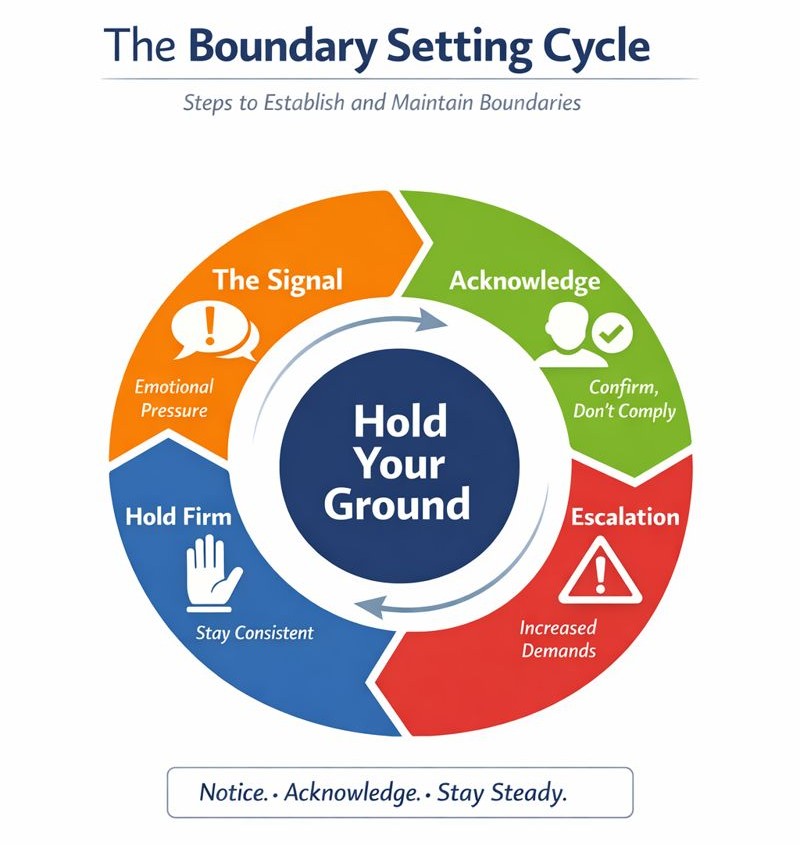
First Test: The Signal
Boundary pressure begins with a signal. This is a communication intended to prompt you to change your behaviour in response to another person’s internal state.
- “I don’t like the way you’re doing that.”
- “This makes me feel bad.”
- “You should help me with this.”
- “If you cared, you would…”
The signal does not directly request action. It implies obligation via emotion.
Response: Confirmation Without Compliance
The correct response to the signal is confirmation, not correction and not compliance.
This involves acknowledging the communication without altering your behaviour:
- “Yes, that’s true.”
- “I understand that.”
- “That’s how it feels for you.”
No reassurance is added. No solution is offered. The feeling is left with the person who generated it.
This prevents emotional offloading while maintaining relational contact.
Escalation
If confirmation does not produce compliance, pressure increases.
Escalation may include:
- Increased emotional intensity
- Repetition of the signal
- Victim positioning
- Threats (withdrawal, self-harm, anger, collapse)
Escalation tests whether emotion can be converted into control.
Boundary Hold
At this stage, the boundary must be held through unchanged behaviour.
Key features:
- No new explanations
- No negotiation under pressure
- No rescuing
- No compensatory kindness
The boundary is expressed through what you do not do, not what you argue.
The Non-Helping Rule
When responsibility is being displaced, helping reinforces the problem.
Do not:
- Solve problems that belong to the other person
- Anticipate needs
- Reduce discomfort created by their choices
Helping is appropriate only when responsibility remains clearly with the other person.
Rules, Options, and Structure
Boundaries are stabilised by rules that do not move.
- Rules apply regardless of mood
- Rules are known in advance
- Rules are enforced by outcome, not punishment
Removing all options produces dependence. Providing fixed options preserves autonomy without surrendering control.
The Responsibility Loop
This model identifies a common destructive loop:
- The other person refuses responsibility
- You compensate
- They escalate
- You compensate more
- Their capacity reduces further
Breaking the loop requires allowing consequences to occur without intervention.
“No” Is a Complete Sentence
A boundary does not require justification.
“No” without explanation prevents negotiation, argument, and emotional leverage.
Explanations invite pressure. Consistency ends it.
Long-Term Effect
This model does not aim to make the other person comfortable. It aims to restore reality, agency, and future capacity.
Boundaries introduce friction. Friction creates learning. Without friction, fantasy persists.
To Summarise...
Notice the signal
- Confirm without complying
- Expect escalation
- Hold behaviour steady
- Do not rescue
- Let consequences teach
This is not a withdrawal. It is a structured presence without submission.